
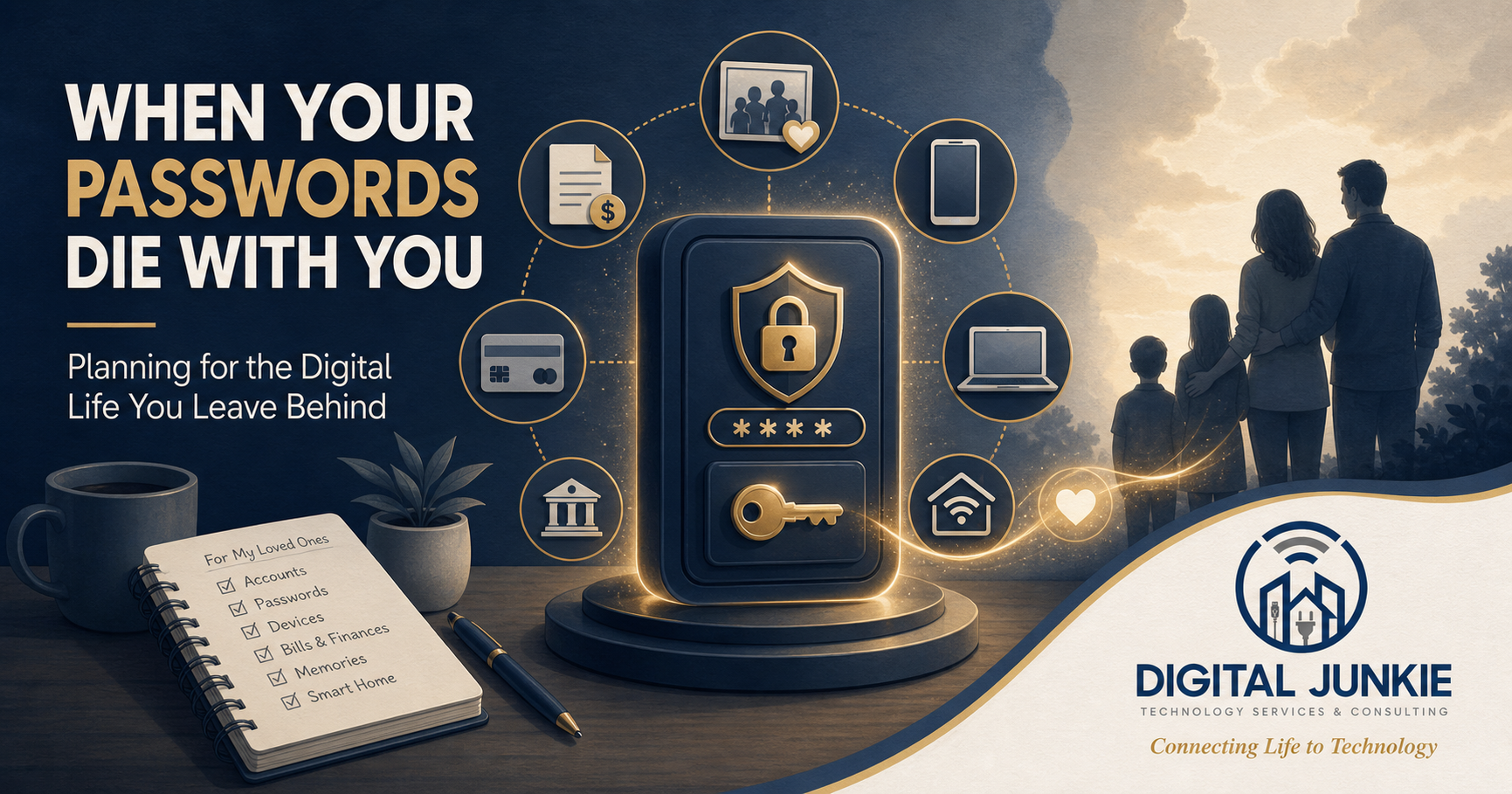
When Your Passwords Die With You: Planning for the Digital Life You Leave Behind
We plan for who will receive our homes, savings, vehicles, and belongings. We create wills, purchase life insurance, name beneficiaries, and tell our families where important papers are stored.
But who will receive the keys to our digital lives?
Today, nearly every part of life has a digital connection. Our bills arrive by email. Our financial statements live behind passwords. Our photographs are stored on phones and in the cloud. Even our doorbells, thermostats, security cameras, and lights may depend on an online account.
Technology companies have made these devices and accounts more secure than ever. Encryption, facial recognition, fingerprint identification, strong passwords, and two-factor authentication help protect our private information from thieves and hackers.
That security is important—but it creates a difficult question:
What happens when someone dies and the people they love cannot get into their devices or accounts?
Locked Out After an Unexpected Loss
Not long ago, a woman contacted me after tragically and unexpectedly losing her son.
Along with the unimaginable grief of losing a child, she faced a problem most families never consider until it happens: she could not access his computer or phone.
She was trying to make sense of the life he had left behind. Were there bills that needed to be paid? Accounts that needed to be closed? Financial or insurance information the family needed to find?
She also hoped to recover something far more personal—photographs, messages, and memories of her son.
But his devices were protected. She did not know the passwords, and modern encryption meant that there was no simple way to get around them.
She was not trying to invade her son’s privacy. She was a grieving mother trying to handle his affairs and preserve pieces of his life.
Unfortunately, a death certificate does not automatically unlock an encrypted computer or phone. In some cases, even the company that made the device cannot recover the information without the correct password, passcode, or recovery key.
Security was doing exactly what it had been designed to do: keeping everyone else out.
That included his family.
Preparing as an Act of Love
Another client contacted me under very different circumstances.
He had terminal cancer and knew that his time was limited. He wanted help preparing his computer so his wife could access the information she would need after his death.
He wanted important files organized. He wanted her to know how to find the household information he normally managed. He wanted to reduce the number of passwords, devices, and confusing accounts she would have to untangle while grieving.
This was more than a computer project.
It was an act of love.
He knew he could not prevent his wife’s grief, but he could remove one burden from her shoulders. By preparing his digital life, he was giving her one less problem to solve during one of the most difficult times she would ever experience.
These two families illustrate the difference that planning can make. One family was forced to search for answers after a sudden tragedy. The other had an opportunity to prepare.
None of us knows which situation our family may face.
What Is Part of Your Digital Life?
Your digital life is much larger than your social-media accounts. It may include:
Computers, phones, tablets, and external drives
Email accounts
Household bills and automatic payments
Bank, retirement, stock, and investment accounts
Tax returns and insurance documents
Password managers and two-factor authentication apps
Family photographs, videos, messages, and contacts
Cloud-storage accounts
Medical portals and records
Social-media profiles
Websites, domain names, and online businesses
Cryptocurrency and digital wallets
Streaming services and other subscriptions
Smart locks, cameras, alarms, thermostats, lights, and doorbells
In many households, one person manages most of these things. If that person becomes seriously ill, incapacitated, or dies, the rest of the family may not even know which accounts exist—much less how to access them.
Accessing an account also is not the same as having legal authority over it. Banks, investment firms, insurance companies, and other institutions have procedures for executors, beneficiaries, and legal representatives. A password does not replace those procedures.
The first step, however, is knowing what exists and where to begin.
A Death Certificate Is Not a Master Password
It is important to understand the difference between a physical device, an online account, and the assets connected to that account.
An encrypted computer or phone may require a password, passcode, or recovery key. The manufacturer may be technically unable to bypass that protection.
An Apple, Microsoft, or Google account is separate from the device. These companies may have procedures for deceased users, but access is not automatic and may be limited to certain cloud information.
Banks, investment firms, insurance companies, and similar organizations follow their own legal procedures. They may require a death certificate, letters testamentary, proof of authority as executor, or other documents.
Gaining access to a cloud account does not necessarily unlock the person’s computer. Unlocking a computer does not necessarily give someone legal authority over the financial accounts found on it.
That is why planning before an emergency is so valuable.
What Do Apple, Google, and Microsoft Offer?
Access is generally controlled by the company providing the account—not necessarily the company that manufactured the computer.
Apple
Apple allows users to designate one or more Legacy Contacts. After the user dies, a Legacy Contact can request access to certain Apple Account and iCloud information using the Legacy Contact access key and proof of death.
Accessible information may include photographs, messages, notes, files, and device backups.
However, some highly protected information is excluded. Apple does not provide Legacy Contacts with data stored in iCloud Keychain, including saved passwords, passkeys, and payment information.
Legacy Contact access also does not guarantee that someone can unlock an encrypted Mac, iPhone, or iPad. Without the device password, passcode, or appropriate recovery method, information stored only on the device may remain inaccessible.
Learn more from Apple’s Legacy Contact guidance.
Google offers an Inactive Account Manager. It allows you to decide what should happen if your account remains inactive for a period of time.
You can choose trusted contacts, determine which information they may receive, and decide whether the account should eventually be deleted. This can cover information from services such as Gmail, Google Drive, and Google Photos, depending on the choices you make.
Google also accepts requests concerning deceased users from immediate family members and legal representatives. However, access is reviewed individually and is not guaranteed.
Learn more about Google’s Inactive Account Manager.
Microsoft and Windows
Microsoft has a legal process for requesting certain information associated with a deceased person’s Microsoft account. Depending on the country and circumstances, a court order or additional legal documentation may be required. Supplying documents does not guarantee that Microsoft can provide the requested content.
A Windows computer protected by BitLocker presents another challenge. Microsoft states that its support staff cannot retrieve, provide, or recreate a lost BitLocker recovery key.
If the key was saved to the person’s Microsoft account, printed, placed on a USB drive, or retained by an employer or school, the drive may be recoverable. Without the correct key, its encrypted files may be permanently inaccessible.
Read Microsoft’s guidance for deceased users and its instructions for finding a BitLocker recovery key.
Create a Digital Estate Plan
A digital estate plan does not need to be complicated. Begin by creating an inventory of the important parts of your digital life.
Record:
Your computers, phones, tablets, and storage devices
Your primary email addresses and account usernames
The financial institutions and insurance companies you use
Your recurring household bills and subscriptions
The location of important documents and photographs
Your password manager and its emergency-access instructions
Your device recovery keys
The administrator accounts for your smart-home equipment
Any websites, domain names, or online businesses you own
Which accounts should be preserved, transferred, memorialized, or deleted
You do not necessarily need to write every password in this document. The inventory can explain where your passwords and recovery information are securely stored.
Choose someone you trust to manage your digital affairs. Depending on your location, your estate-planning attorney may be able to formally name that person as a digital executor or include appropriate digital-asset language in your estate documents.
Store the Plan Safely
A list containing every password can create a serious security risk if it falls into the wrong hands. It may also be unwise to place passwords directly in a will, because wills can become public records.
Safer possibilities include:
A reputable password manager with an emergency-access feature
A secure physical safe
A sealed document kept with an attorney
Recovery keys stored separately from the encrypted devices
Estate documents that explain where credentials are stored
Written instructions given to a trusted representative
Make sure the appropriate person knows that the plan exists and knows where to find it. A perfectly organized plan is not helpful if nobody knows about it.
Review the information at least once a year and after major life changes such as marriage, divorce, serious illness, the death of a family member, or replacing a primary phone or computer.
Because laws and company policies vary, consider discussing your plan with a qualified estate-planning attorney.
Five Things You Can Do This Week
You do not have to solve everything at once. Start with five steps:
Choose someone you trust to handle your digital affairs.
Create an inventory of your important devices and accounts.
Configure Apple Legacy Contact and Google Inactive Account Manager where applicable.
Securely store your device recovery keys and password-manager instructions.
Tell your family or representative where the plan is located.
These steps may take only a small amount of your time, but they could save your family days or weeks of confusion.
One More Way to Care for the People You Love
Digital estate planning is not really about computers.
It is about the people who may one day find themselves sitting in front of those computers, searching for answers during one of the hardest moments of their lives.
It is about the spouse trying to find the household bills. The child searching for an insurance policy. The parent hoping to recover one more photograph. The family trying to manage a smart home that nobody else knows how to operate.
We cannot remove the grief our loved ones may one day experience. But with a little preparation, we can remove some of the confusion, frustration, and fear.
We plan our estates because we care about what happens to the people and possessions we leave behind.
It is time to plan for our digital lives, too.
You Don’t Have to Plan It Alone
If you are unsure where to begin, I can help you organize your devices, identify important accounts, securely document recovery information, and prepare a digital plan your loved ones can understand.
Whether you are planning ahead for yourself, helping an aging parent, or facing a serious illness in your family, the best time to sort through your digital life is before access becomes an emergency.
Contact me to schedule a digital estate planning consultation. Together, we can help make sure the people you love are not left digitally locked out.